Aquanaria

Aquanaria

Monday, 8 February 2010

Liver little and try something unique

Every now and then a treat turns up on our fish counter. This time it was monkfish liver. A unique delicacy, and important to me I can deem it ethical; it is a by product that is usually cast back overboard. You see most unusual delicacies fit into the unique groups of endangered or critically endangered – Dodo eggs for example are covered by one of these.  Anyhow, whilst the South-West fisherman attempt to gain accreditation from the marine stewardship council (MSC) for the sustainable status of their (I use 'their' loosely as we technically all own these fish) sole and monkfish grounds we can comfortably assume that levels of monkfish off our Cornish peninsula are sound. Of course I am aware stock levels of monkfish in other catch areas, the Bay of Biscay for example, are in a severe or even a critical status, however, I am not sourcing my products from these fisheries.

I have a simple recipe for monkfish liver that was given to me by a customer a couple of years ago. However, I decided to search through my large selection of fish cookery books to find Rick Stein or Keith Floyd’s recommendations on preparation and serving. Hang on nothing, not a mention. Has Rick Stein never heard of it? Did Keith Floyd leave his in a bag on the fish counter whilst in a rush to catch the Offie before it closed? Searching the internet also offered little helpful information apart from its application in Japanese cuisine. 


The simple but effective recipe:


Season the liver well then dust in flour.
Pan fry in butter until crispy on each side.
When done add a squeeze of lemon or drop of vinegar to the pan.
Roll onto a warmed plate and serve with crusty brown bread.

Alternative recipe

Monkfish Liver, bacon and pea shoot salad with a poached hen's egg
http://tinyurl.com/yhcpeme

It is very rich and has a creamy texture and maybe a small amount, 100grms per person, is needed. To my surprise it didn’t sell that well, but I put that down to receiving it on the wrong day of the week. I will try again so many of you can taste this delight.

Monday, 18 January 2010

Nets and Fish - The old fashioned way

In my recent past I was lucky enough to be part of a successful fisheries consultancy firm. We undertook the dirty work behind the scenes whilst the larger contractors and engineering firms took the glory on the back  of their press conferences. However, our work was by far the most enjoyable. Although a little dated I thought I would share this piece from my old, and fairly static website, With a View to Fisheries. I thought it would be of interest to those who are interested in fish and those many London follows that would have driven past this reservoir on numerous occasions.

Seine netting contracts are commonly undertaken in conjunction with a full or partly drained water body. However, certain situations require further, more complex measures. Occasionally reservoirs are almost completely drained for one of three reasons. Designated filler reservoirs are commonly seen to have extremely low water levels come the end of the summer. Whether for drinking water purposes or feeding canals and rivers these water bodies lose water, however, the levels are controlled and observed daily which minimises the risk to fish stocks. More commonly the stock levels are calculated with water loss in mind thus problems are rare.

The second reason for dewatering directly relates to fisheries. The easiest way to crop or catch fish or a designated species is to remove their medium, water. Reservoirs are commonly used as stock ponds, therefore they are periodically drained. Again little problems are envisaged with this procedure as the water is usually well known by the contractors or owners and the knowledge and equipment is already in place. Conversely, islands or reed beds may need adding or altering thus water levels have to be dropped. The final, and most relevant, reason behind water removal regards large-scale engineering works. Dams leak, sluices block, silt deposits accrual and weed becomes out of hand. These all require plant and machinery which indicates access to difficult areas. Water needs to be removed to carry out these jobs - some times all of it!!

So why do fishery consultants become involved with large-scale drain downs? More emphasis is put onto the environmental issues than ever before and as one can imagine a large-scale fish loss is totally unacceptable. Fish that derive from the drained water body are usually dealt with in one of two ways. They can be stored in designated areas, ponds or lakes, or they can be removed from the site, sold and then replaced when the reservoir is re-filled. The reservoir owners or their designated fishery manager takes this decision. In December 2001 MEM Fisheries Ltd undertook one of the aforementioned drain downs which has offered me a case study to explain such procedures.


Site Description
Brent Reservoir (also known as the Welsh harp) is situated at the foot of the M1 motorway in the London Borough of Brent. This disused filler reservoir is approximately 110 acres in size and is used for many water activities - ironically angling is not undertaken on the reservoir. The reservoir is owned by British Waterways with John Ellis, Fisheries and Environmental manager, BW South East over seeing the fish removal. The image below shows the immense scale of the reservoir  and an early morning sunset.


On the bottom of the aerial view the reservoir dam can be seen. Just to the right of centre is the sluice tower and this is where all of the following photographs have been taken from. The reservoir is gravity drained, a more efficient and cost effective method than pumping. It was drained very slowly as the reservoir has high silt levels thus increased water flow would cause this substrate to be sent down the river. The water is deposited into the River Brent via an advanced mechanically controlled sluice system. This sluice was the area of concern and the cause of the reservoir drain down. A section needed replacing and as it was situated at the bottom of the deepest area of the reservoir all of the water was needed to be removed.

The biggest concern with any drain down is knowing quite where the water is going to end up. Now, in theory the water will always drain to the deepest end, this is true for all sites. Unfortunately many lakes and reservoirs have uneven beds that tend to leave many pools of water scattered across the area. Deep silt deposits make retrieving fish from these hold ups very difficult and very time consuming. In general the contours of the lake bed should be assessed to allow the proper planning of large scale jobs; this is easiest done with an echo sounder. Fortunately, Brent Reservoir was drained 8 years ago for similar engineering reasons thus it was known exactly where the fish would be in the final stages. Commonly though, larger waters, when drained, are being done for the first time, therefore prior knowledge is unavailable. Bad planning will result is fish loss, a totally unacceptable and unnecessary scenario.

Job Preparation
It had been decided, in collaboration with English Nature and The Environment Agency, that the fish were to be stored in two secure canal pounds situated at Hanwell on the Grand Union Canal. These pounds would be closed to boat traffic use and were alongside British Waterway's offices for extra security. The stock densities of short canal pounds are commonly low, therefore a small-scale netting and electrofishing operation was undertaken to remove the original stock. These fish were allocated to the canal above and below the secure pounds; migration is common in canals thus fish would soon return to the holding pounds when the Brent Reservoir project was completed. After this small exercise was accomplished the drain down could commence.

The Netting


At low water level the access to the dam section was difficult. A small boat was the only option as it needed pulling across the silt to the remaining water. Seine netting was the only option available to catch the fish safely and quickly. Due to the silt levels and unknown quantities of fish a relatively small 180-metre seine net was used. Large quantities of juvenile fish combined with thick gill blocking silt would spell disaster. Although the activity of the larger fish in a landed seine net will clear large quantities of silt smaller fish tend to perish, therefore it was imperative not to over catch in any one single net.

The three pictures above outline the process of laying the seine net. The net was loaded onto the boat and then laid in a semi circular shape. The sluice tower is shown in the image on the right; the majority of the netting took place to the left of this tower. These images were taken about 6 days into the operation; there was approximately a further 7 acres of water at the start of netting. The net was reasonably heavy to land and required 4 men to achieve this task. The two main problems were silt levels and the deep sump hole in front of the tower. The silt in the net had a tendency to slide down the sump causing strain and pain to those left pulling the net.


With such a steep dam coupled with large quantities of silt the net was extremely heavy when it was time for the leads to be pulled in. On occasions three people were needed to hold up the corks to stop them from being towed underneath the water surface. A benefit was the solid concrete dam that allowed excellent grip under foot. It is common to be waist deep in silt at the net landing stage. The image above shows the leads being pulled in whilst the net and cork line is eased up the shelf. This is the most important stage of any netting as one false move would result in total loss of fish.

The Catch
As previously mentioned Brent Reservoir was drained 8 years prior to this fish rescue. The reservoir bed was exposed to the air for 3 months with the addition of many heavy frosts. This allows the break down of silt deposits and an overall increase of fertility with regards to promotion of fauna and flora. The benefits of this were directly shown in the current yield of fish. Even with high cormorant populations the total stock level had increased by 70% to that of 7 years before. Year classes of all fish were present compared to just roach the previous time. Only small numbers of carp and tench between 8oz and 1lb 8oz were caught. These were severely damaged by cormorants, therefore the levels of these species lower year classes could have been much higher. However, the carp and tench had spawned and achieved a mild success rate. All year classes of roach were present and healthy, bream and perch were also present alongside various gold fish and ornamentals, obviously stocked by the public. There were pike into double figures and carp to over twenty pounds. The three pictures below show the fish in all their glory. Top and Bottom are the vast quantities of silver fish yielded by the reservoir. The centre image shows one of the ornamentals, in this case a white Koi carp.


The Fish Movement
Although catching the fish was a fairly straightforward process the removal and loading was far from easy. The small obstacle of a concrete dam wall stood in the way of easy loading. The only efficient way to get fish from the water to the tanks at the top of the dam was through sheer hard work. Slings of fish, approximately 20 lbs in weight, were loaded and then carried to the base of the wall. A rope was attached to the sling and then it was manually hauled to the top where the fish could be released into the tank. The period of the drain down saw over 1000 slings of fish pulled to the top of the dam. The relatively poor water quality, mainly caused by the silt, meant that the fish needed to be removed and loaded into clean, oxygenated water as quickly as possible.


As small fish tend to reside at the surface of the net, thus easily caught, a tank was designated for 0-2+ silver fish. This would remove the additional stress caused by larger fish charging around inside a tank. Carp and larger fish traveled separately as their lower dissolved oxygen requirements meant higher quantities can be moved together. The very low water temperatures allowed up to 900lbs of fish to be transported in one tank at any one time. Providing the water is clean, the temperature is low and the correct level of oxygen coupled with the correct diffusers are used there is no reason why 1200lbs of carp (850lbs of roach) cannot be successfully transported in one tank. The fish were loaded and taken to Hanwell where they were stocked into their temporary home.


With regards to water drainage Brent Reservoir is very efficient. Although silt levels are high and access is relatively poor the water does drain to one point on the dam. No pools of any note are left, therefore all of the fish can be successfully caught with nets. Once the water had been drained to a small pool approximately 7 square metres in size only one carp was left to rescue. The continued dragging of a seine net had resulted in the successful removal of all the fish resident in the reservoir. Overall a comparatively easy drain down to complete.

Re-capturing and returning Brent's stock
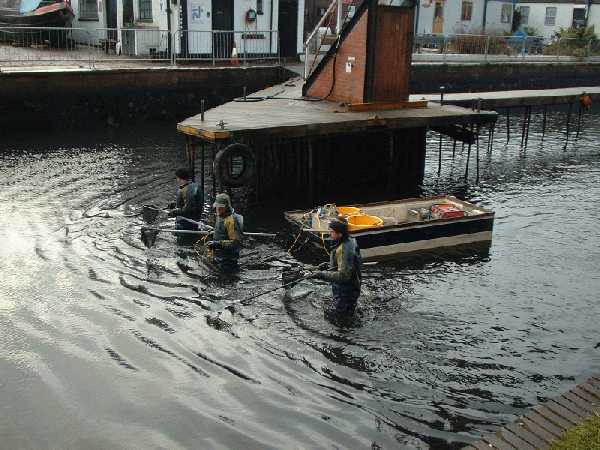
The re-capture of the fish required a very different process. Small nets, 50 metres in length, were dragged along the canal where they met strategically positioned stop nets. These stop nets are used to break up a length of canal into easily manageable sections. The net is then closed to the bank and landed. This process can be seen in the photographs below. The biggest problem encountered with netting urban canals is the multitude of items thrown in by the public. Bicycles, lawn mowers umbrellas etc all need removing before successful nets can be landed. The only way to find these items is by dragging the nets, therefore continued de-snagging was required.


The pictures below show some of the fish being returned to a brim full Brent Reservoir. On the top is one of the very large carp and the right is our friend, the white Koi, returning home. Our very own Professor Parr is holding both of the fish. The centre picture illustrates one of many nets of roach and silver fish being released. Although the natural stocks require a large return of small fish many resident fish eating birds also welcomed the re-stocking of such species.


Conclusion
The drain down, fish removal and engineering works on Brent reservoir in 2001/02 were a resounding success. Many thousands of fish were safely stored whilst large scale works were carried out. However, the picture below shows a frozen Brent Reservoir on Christmas Eve proving Mother Nature will always intervene if every thing is going to plan. This weather caused a cessation in work for over two weeks. It is highly unlikely Brent will be drained again in the foreseeable future, however, if the stock continues to thrive in a similar fashion to 8 years ago Brent Reservoir will once again become a successful haven for a diverse selection of fish species and fish eating birds.


Wednesday, 13 January 2010

A New Year, Roes and Very Poor Shows

Moving into the New Year is a testing time for us mongers. We have sub zero temperatures to endure (-7 lowest so far and we have no front door), slippery pavements, transport problems and customers watching their pennies. But the most difficult and testing part is the explaining to people that many fish are out of season. “Fish have seasons! You learn something everyday” was the most recent remark, but they do, and very distinct ones. At this time of year many round and flat fish are preparing to reproduce. The utmost effort is aimed towards the production of gametes, milt or roe, with little emphasis on flesh production. Already the good quality flatfish, such as plaice, have almost disappeared from sale. Plaice are a particularly good example as they produce huge roes that has a major detriment to the quality of the flesh. Those fishmongers that only offer line caught species such as Bass, Red Mullet and Mackerel will also see these dwindle as many fisheries will self impose a closure to protect their future stock levels. Dover Sole, and to some extent Lemon Sole, will now start to roe and only the discerning fishmongers will be selective with what they offer; for those that aren't this is a very poor show. Of course I wish it was simple but fish across vast water bodies have their own seasons so spawning species in one area may have already spawned in another area. So I suggest you ‘look at the show and avoid the roe’ as a better quality product will be your prize.

Sunday, 20 December 2009

Fish, Wine, and a Jolly Good Time


I have never blogged about dinning experiences in restaurants as a) not sure I have experienced enough good food to compare and b) many others do the restaurant reviewing so well. Two or three times a year I undertake the fish extravaganza at my flat where a few join my wife and i for numerous fish courses accompanied by much lovely wine; last nights was quite unique. My wife was away for this one so I was joined by my boss and a work colleague and two fellow Chelsea green workers, one, Jimbo, whom is a director of top wine merchants Haynes, Hanson and Clark. Jim supplied the wine and until this dinner I hadn’t realised how real wine tasted.

We started our dinner with some fantastic wild south coast native oysters and a select few Maldon rock oysters. Both of these are just sublime, clean tasting with fantastic textures. With just a squeeze of lemon and a glass of 2002 vintage Pierre Vaudon the perfect start to any fish meal.


On the night a couple of the courses stood out for everyone. The first out was my home cured gravlax, cut slightly thick and accompanied by a horseradish and mustard cream sauce. They blended fantastically together and I was delighted with the outcome. Accompanied by a Sancerre Terre de Maimbray 2008, probably my favourite white of the evening, this course was enjoyed by all.


Of course as the night went on my cooking suffered due to blurred vision. However at this part of the night I was still running on all cylinders and my classic fish soup was just sublime and enjoyed by all. This dish has never been a favourite of mine but recently I ate at Racine on Knightsbridge and Henry Harris really inspired me with his fish soup that was absolutely delightful. Mine didn’t match his but it was very good. It is difficult to obtain the correct fish for this dish so I used red mullet, monkfish, conger and gurnard and served it with rouille and my only cheat of the night – shop bought croutons. Poured with this course was a Steinerrassen Riesling 2006.


After a short rest we moved onto grilled scallop with hazelnut and coriander butter (a Rick Stein recipe). The scallops I used were jumbo Scottish hand dived beauties that weighed over 120grms which is 4-5 times the size of your average scallop. The butter was beautiful, but maybe the scallops were not warmed enough. I underestimated their size and the failings of my grill. However, they tasted fabulous and the wine served, a 2006 Chablis Grand Cru Vaudesir was amazing.


My spaghetti vongole was a bit of a disaster. It tasted very nice but I was just too pissed to make the most of the spaghetti I had made earlier. Such a shame as it is one of my favourite dishes but you can’t win them all. Fortunately the 2003 Chabllis Grand Cru Clos saved the day as it was so fantastic it moved talk away from the poor course I had just served.


I clawed back some dignity with my John Dory en papillote which is cooked with cherry tomatoes, black olives and fine green beans. This is one of my all time favourite dishes and the simplicity of the dish compliments the delicate nature of the fillet. With the white wine finished we moved onto a couple of amazing reds. Firstly a 2004 Nuit-Saint-Georges 1er Cru Les Chaignots followed by the piste de resistance a 2001 Clos des Lambrays Grand Cru.


I suppose we should have been full by then but a huge amount of cheese, including and amazing pecorino with black and white truffles, and a bottle of port passed us by and then straight from the silverspoon cookbook four of us managed to consume a tiramisu at about 2:30 in the morning.


Almost forgot the final tipple that being the Syndicate 58/6 12 year old


Normally these parties are all about the fish but I am happy to say the wine took centre stage

Saturday, 28 November 2009

Old Birds & Old Fish - Magical museum exibits

Probably your first visit to London was to the Natural History museum. A magnificent building idealistic of the age it was built in with memorising gargoyles' and figurines now staring down on the cueing tourists. A statue of Thomas Huxley greats you as you enter the main doors, the man so in favour of Darwin theories, and so against one of the original museum curators Professor Richard Owen creationist views. As you enter the building the breathtaking high ceilings become engrossing and the architecture just mesmerising and then ….. you head for the dinosaurs!!! 

I love this museum and am unsure how many times I have visited it even though it now seems geared only towards children and foreign tourists. My monthly trip leads me to only four exhibits and it is the same four every time, but to me, they are the only four. Firstly the Mary Anning collection incorporating the plesiosaurs and ichthyosaurs. There is something so very close to home about this collection mostly from the Lyme Regis area. Each fossil has its own story. 


A left turn then takes me to the stuffed replica Dodos. One has to remember no preserved Dodos exist so my ears are covered when hearing a teacher tell his pupils they are real. The story is amazing considering that all stuffed offerings are modelled from drawings; not even a complete skeleton remains. This is a real story of humans’ ability to remove a species in a 35 year period.


From the Dodo I meander pass the children to the memorising display of hummingbirds (Victorian period) pinned to a board. There is something addictive about gazing into this glass case at these beautiful birds until that sick feeling of what you really are looking at hits you. From there I walk straight across the main hall to a small glass tank of formaldehyde sat lonely in an alcove. As I stand there transfixed on a pale white fish people walk to the tank, glance, dismiss, and walk away. Not a second thought is given to the importance of what is in front of them. They throw their eyes at the meaningless tiny plaque that only states ‘coelacanth Latimeria chalumnae Smith, 1939. No body offers more than 10 seconds of their time to study my friend and the museum offers no information as to why they should. At a point in the late 1930s this fish was thought to be the link between wet and dry. The papers were littered with ‘missing link’ headlines. A worldwide hunt started for another specimen leading to an international incident involving France and South Africa. Ultimately the fish was proved not to be the walking miracle once thought but the story behind Marjorie Latimer’s first discovery in 1938 and the events that followed just show how important the scientific world deem these findings. Amazingly it hit the news again in 1998 when a couple of marine biologists on honeymoon in Indonesia spotted one on a wooden trolley in a fish market. This fish was thought only to habit the areas around the Comoros off Eastern Africa. More history was in the making. 


My visits to the Natural History Museum are short and sweet. I hope, however, on your next visit you might take a look at the ichthyosaurs and Dodos, the Hummingbirds and my friend the coelacanth in a new light and for more than 10 seconds.

'The Dinosaur Hunters' Deborah Cadbury ISBN; 1-85702-963-1 
'Dodo from extinction to icon' Errol Fuller ISBN: 0-00-714572-1
'A fish caught in time-The search for the coelcanth' Samantha Weinberg ISBN: 1-85702-907-0


Friday, 27 November 2009

Tuna - The unconsidered alternative

As the wave of opinion gets behind the recent campaign to save the blufin tuna are other key issues being blinkered by this rolling bandwagon? I do not profess to be an expert on the state of tuna fisheries but it is documented well enough to believe that certain stocks of blufin are critically endangered. Any species of endangered animal should be protected and no one could argue against that. The West is the backbone of the recent anti blufin campaign, the very parts of the world that’s insatiable appetite for sashimi has helped to cause such depletions in stock levels. Of course Japan have a lot to answer for but they have, however, been using these species in cuisine for a very long time compared to Europe and the US. So the two problems occur. Firstly what happens to the countries and their fishing fleets that have invested so much money into the infrastructure for catching blufin? The very people encouraged to catch blufin to supply London, Paris and New York? The very people now being blamed for trying to make a living out of an industry the West has turned its back on? The very people that know no other way of life? No wonder the blufin catching countries will not ratify treaties outlawing the capture of their 'own oil'. And secondly, and the most overlooked and crucial point in my opinion, the opinion of a fisheries scientist, is what will happen to the alternative? Well if blufin imports to Japan can be outlawed, the only true way to conserve the species, then a replacement will be required and it will only be the yellow fin Tuna that offers similar tastes and textures. So while we rejoice in saving of the blufin, while we congratulate ourselves on how we forced our hand on many underdeveloped countries and made them change their ways the yellow fin will be shaking its tail in fear. The world is coming to get you – you are the alternative!

Thursday, 26 November 2009

Zander - Coming to a canal, or dinner plate, near you


The other day a customer told me about a fish. He was very pleased that he new about a species we didn’t sell and even spelt it’s name to me. He explained where it was caught, its life history and what it tasted like; the subject had arose as he had eaten it recently in a pub in Kent. Off he went smug in the fact that he had spread his knowledge. The fish in question was a zander (z  a  n  d  e  r) and contrary to popular belief is NOT a cross between a pike and a perch. Just so happened I knew an awful lot about this fish as in the early part of this decade I was involved in an extensive zander culling exercises undertaken on the canal networks of central England. Not since pre ice age was the zander indigenous to the UK. It was re introduced illegally in the 1950s into the Great Ouse and then spread across the linked waterways of the midlands and can now be found as far south as the River Thames. They are a pretty destructive predatorial species that not only seem to hunt in packs but also, due to impressive eye sight, succeed exceptionally well in coloured water; canals are an ideal environment. Over a 20 year period they have successfully depleted many indigenous species across the midlands and the south.


A couple of big Zander from the Trent & Mersey Canal (i'm looking young)


I have eaten this fish many times and it is not that bad. As it is a carnivore and not a benthic forager (like a carp) there is no real problem with muddy tastes. People will say it’s bony, but it only has a similar bone structure to a sea bass. The scales are particularly abrasive so I would suggest skinning the fillet.


Zander In Bacon Wrap With Caramelized Chicory On Carrot Puree Recipe 

Zander fillets in cream and herbs 


Fillets of Gloucestershire zander with duck egg, asparagus and crayfish 


Tuesday, 24 November 2009

London's reliance upon the South West

Ok, so we can’t get ANY fish at all as the winds keep blowing but when all is fine London and the South really does rely upon the South West fish markets. Recent figures published in the Fishing News show quite how large the landings are at Plymouth, Newlyn and Brixham and to my joy Newlyn leads the way. Well done boys and if you could just make your minds up regarding market modernisation you may just keep this title.


Port          *Demersal   **Pelagic      Shellfish          Total

Newlyn     £7,866,615    £436,488   £1,704,632    £10,007,735

Brixham    £5,093,629    £157,528   £3,833,638    £9,084,795

Plymouth  £1,991,377    £2,709,280 £2,088,775    £6,789,432

*   Ground fish such as soles, skates etc
** Midwater fish such as mackerel and sardines

Saturday, 21 November 2009

My old vocation - rescuing fish

As many of you know I have a background in fish that stretches further than mongery. One of the most enjoyable parts of an old job was to get wet and dirty with the fish. I wrote the account below for my old fisheries management website that details how we removed the fish out of those canals you all drive over – enjoy.


The United Kingdom has a fairly extensive canal network with lengths from Exeter in Devon to Edinburgh in Scotland. Through the mid 19 hundreds the canals became rather disused; this was due to commercial goods transport moving to the road and rail networks. However, over the past 15 years the canal has returned into the limelight with huge grants allowing essential maintenance; this is especially the case on the Kennet & Avon canal in Devizes and the Union Canal in Falkirk. This increased interest, and some may suggest trend, in living by waterways has encouraged the canal owners, British Waterways, to continue with essential work to maintain the network. So with all of this work underway how and why do fishery consultants become involved? The canals have always been a favourite haunt for anglers; this has resulted in thousands of pounds of fish being stocked over the past twenty years. On many occasions the scheduled work requires the removal of the water. The replacement of lock gates, repairs to culverts, lining of canal beds, dredging and piling are common practice, but before these essential works can commence the canal section requires de-watering.


These three images show why water is removed from canal sections. The picture at the top was taken at Farmers Bridge, Birmingham on the Birmingham & Fazeley Canal where extensive re-development work was being undertaken. A series of lock pounds were drained to allow bank side renovation to take place; the aim was to rejuvenate the area with new housing and office buildings. Of the twelve pounds along the Farmers bridge length all but one drained to an efficient narrow section on the towpath side. The image in the centre shows a lock gate renovation work at Cosgrove on the Grand Union Canal Main Line near Northampton. The removal of lock gates will always lead to de-watering. However, as many locks have a bridge situated close by the use of stop planks can be employed hence leaving short drained sections. On occasions a further problem is uncovered once the section has been de-watered. At Cosgrove (image at bottom) a hole was located in the bank, but luckily four grade 1 British Waterways staff were on hand and were left to look into it!!!


There are various ways to de-water a section of canal. Two solid barriers are required; therefore, short pounds with adjoining locks are ideal. Unfortunately this scenario is rare so other water retaining methods need to be employed. Stop planks can be placed in the purpose cut grooves located underneath bridges.


When the use of stop planks and lock gates as dams is not possible temporary structures are required to hold vast quantities of water back. The common choice is the use of an impervious fabric membrane attached to a free standing steel support system. These Portadams are fixed across the canal, shown in the above pictures (Horton Bridge, Kennet & Avon Canal), and then with a slow drain down the sheet is allowed to seal creating a water tight barrier. This system allows work to be undertaken on otherwise non-accessible sections. However, they have a tendency to breech, especially in the more silty sections, so jobs are commonly held up while complete sealing takes place.


These two images show the completed dams in place. At the top is the dam at Horton on the K&A Canal; note the drag net can be seen still in place behind the now completed dam. Below is the fitted dam at sheepcote street, Birmingham. This was a larger dam thus did experience many problems before a seal was achieved. The ideal conditions for a successful fish rescue consist of a width near to 4 metres and a depth 0.45 metres. However, these conditions are rare due to the varied contours found on the many different sections of canal. Silt deposit levels and recent dredging exploits also influence depths. Whatever the conditions presented the rescue needs to be completed, therefore methods vary to suit each job.

The concept is simple. A small boat is pulled along the canal section behind 3 - 4 electrofishermen. The boat contains a generator linked to a control box. From this box run two hand held anodes and one cathode; this is connected to the rear of the boat. 240 volts and 6 amperes are generated and a direct current is implemented. The current is applied via the use of two "dead man's switches", one on each anode. Also within the boat there can be up to four large bins of water which hold the captured fish.; each bin has an aerator pipe that is connected to a battery powered air pump. Up to three stop nets of various sizes can also be carried. Each bin can hold up to 100lbs of large fish or 50lbs of small before they need to be emptied.

With a three man team the outside men will control the anodes, sweeping left to right, whilst the centre man controls the boat. Each team member will also use a small net to collect stunned fish. Large nets are held in the boat if substantial amounts of fish are encountered. If a forth team member is utilized the man can be placed in one of two positions. If the presented canal still has a wide area of water the forth man would be suited at the front alongside his team members. However, if conditions are either 1) good (narrow); he can follow behind netting the smaller fish that rise late (usually perch & ruffe), or 2) Very silty; he will probably have to push the boat if the substrate offers difficult walking conditions.

The length of the canal section is the usual determining factor that dictates where the job will commence. It is beneficial to work into clear water, therefore, if groundwater is entering on the length then the electrofishing should always take place towards the source. However, if the section is being pumped or drained whilst the rescue is in progress then working away from the running pumps or open paddles is again preferable. Incidentally, it is not always possible to fish into clear water as accesses are not always available to launch the boat from.

Once a suitable area has been found for launching, and the water flows and colour has been assessed, the work can commence. The process is fairly simple, however, there is one hard and fast rule. No matter what conditions are presented the job is not complete until all of the fish have been removed. This could mean up to four runs of the whole length; usually two complete runs are sufficient to remove the fish.


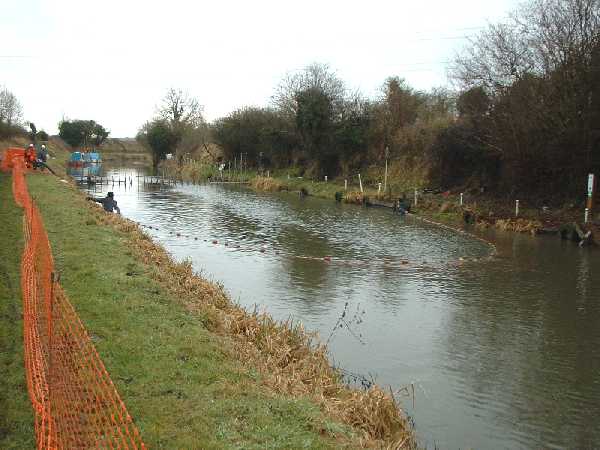
These three pictures show a successful fish rescue in progress at Yelvertoft on the Leicester Line of the Grand Union Canal. These conditions are almost perfect offering a narrow canal and constant depth. The silt levels through the boat channel are low which allows easy walking conditions. Unfortunately I needed to leave the water to take these pictures, however, with the offered conditions I would have been seen approximately 20 metres behind the boat collecting the smaller ruffe and perch that show late. The electrofishermen can be seen on each side with a hand held anode and an accompanying netsman in the centre. The pictures givesa good indication of the parallel line kept by the probe users. If one were to fall behind, this coinciding with large numbers of fish, then the fish shoal will tend to charge the withdrawn side. If kept level the fish are moved slowly up the canal until they meet a solid barrier; a net can be dropped behind at this point trapping the fish into a short section. The creation of a diagonal current caused by a withdrawn anode will cause increasing problems as a section becomes wider. The section above is sufficiently narrow so not to be effected by sloppy working practices.


The picture on the top gives a clear view of the contents inside the electrofishing boat. The electric box can be seen on the front of the boat (grey) with the yellow cables of each anode attached via specialised waterproof four pin plugs; the UK standard colour for these plugs is blue/grey. The box is connected to the generator (red) which is situated in the rear of the boat. The generator can usually be found in the rear as it counteracts the water bins (yellow) in the front. To the left of the generator the air pump can been seen; the pipes and diffusers from this pump run to the water bins. There can be up to five bins in the boat at any given time. The picture on the bottom shows an electrofisherman (that's me) working an anode whilst netting small roach. He can be seen in a full dry suit and gloves, the only realistic clothing to carry out fish rescues in.


These two pictures show the working conditions in and around solid structures. The image above shows a simple lock system that requires navigating before the next section can be fished. Note the large amount of ice in the lock; never assume all jobs are warm and fun!! The second image gives an excellent view when approaching a portadam.


On occasions it is possible to carry out a drag down with a net before a dam is put in place. These pictures, taken at Horton Bridge, near Devizes on the Kennet & Avon Canal, show the aforementioned drag down in progress. This method has shown to be very effective in herding shoals of bream and large roach from the target section. Years of scientific testing, with regards to the effect of electrofishing on certain species, has continuously revealed potential damage to fish when exposed to long bursts of electrical current. Therefore, any opportunity to remove fish from the section with methods other than electricity will always be employed.

A canal drag-down is usually undertaken with a small seine net rarely exceeding 25 metres in length. Again the concept is simple. The net needs to be a sufficient depth to cope with the drag-down; therefore, a net exceeding 1 metre at the deepest point of the canal is required. A man works each bank from the water by pulling the net towards the dam frame; it is imperative that the net stays of equal distance between workmen. The middle of the net needs to be in the centre of the canal. The images above show the net being pulled towards the dam frame (top) and of the excess net bulging behind as the net is pulled (centre). Incidentally, this method is not always feasible as dragging nets is both time consuming and energy sapping. In reality very long stretches cannot be netted as the efficiency decreases over long lengths due to snags.

As a net is pulled through a section numerous obstacles will be encountered. Many areas of canal are used as dumping grounds for all types of rubbish; this will affect the efficiency of any drag-down. As these snags are uncovered the leads attached to the base of the net need careful manoeuvring over the obstacle. The worst type of snags include bicycles, tree branches and brambles and the mandatory car engine. However, if the canal is not to deep most problems can be solved. This image (bottom) shows a large branch being removed from the net.


These two images taken at Sheepcote Street, Birmingham on the Birmingham & Worcester Canal, show a relatively inefficient electrofishing exercise. The catch efficiency of a canal section drained to this width would be less than 50%, however circumstances sometimes dictate that rescues need to go ahead. This section had prolonged problems with holding water back, but the section was finally drained and a successful rescue was completed.


Occasionally some very difficult conditions are put in front of a rescue procedure. As many rescues are linked with hugely expensive civil engineering projects the time scale available is always short. Therefore, problems other than deep water, which cannot be solved, require tackling and over coming. These two images were taken in January 2002 at Yelvertoft on the Grand Union canal Leicester Line. This stretch was approximately 2200 metres in length and when presented had 2 inches of ice across the surface. For obvious reasons a rescue could not be undertaken, the only solution was to launch the boat, find some heavy poles, and then tow the boat whilst breaking the ice.