I've just finished collating information for a report on UK MSC fisheries (wetfish only) for a customer and it makes interesting reading. They are determine to use only line caught British MSC accredited fish and will hear no different to this master plan of thiers.
Unfortunately the one snag to this plan is there are a total of only 15 accredited fisheries
1 Dover Sole
1 Coley
1 Cod
1 Haddock
1 Sardine
5 herring
5 Mackerel
One of the mackerel fisheries has an element of their fleet as hand liners (less than 40%) other than that the other 14.5 fisheries are trawled.
Should make for an interesting meeting, wish me luck.
Aquanaria

Tuesday, 10 July 2012

Monday, 2 July 2012
I Bloody Love Brill
I'm always asked 'what is your favourite fish to eat?'. Well that's always a tough one as halibut, wild sea trout and wild gilt head bream are always strong favourites, however, brill always tickles my taste buds. Brill is a fabulous fish to look at, to talk about, to work with, to cook with and of course to eat. My very favourite brill recipe involves cooking with red wine *eye lids raised*. Yes I know its not 'correct' to cook white fish in rouge but a robust red adds colour and richness and really does work.
Fillets of Brill in Red Wine
My good friends at Newlyn Fish Company were kind enough to send me a fantastic 900grm brill, a good size for two, and after much hacking I managed to get two acceptable fillets from the fish (scaled first).


Ingredients (serves 2) Preheat oven at 180c/gas mark 4
2 Fillets of brill
100ml Fish stock
100ml Red Wine
75grm Butter
60grm sliced Shallots
salt and pepper
For this you need a nice big flame-proof dish in which the fillets will not overlap. Grease the dish with butter, lay in the shallots, season the fillets well and lay them on the shallots. You can either have the fillets skinned or have the skin scaled depending on if you are partial to skin or not. Pour in the red wine and fish stock, cover and bring to just below boiling point.


Once the liquid has reached just below boiling point remove from stove and place into the top of the pre heated oven for 6-8 minutes until the brill is just cooked.

Remove the fillets and shallots gently onto warmed plates and return the flame proof dish to the hob and boil the remaining liquid rapidly until reduced by half. Whisk in a few small pieces of diced butter until you have a smooth shiny sauce. Split all evenly and maybe serve with some Jersey royals and seasonal veg.

Ok my presentation is much but taste wise its a beautiful dish and well worth a try.
Fillets of Brill in Red Wine
My good friends at Newlyn Fish Company were kind enough to send me a fantastic 900grm brill, a good size for two, and after much hacking I managed to get two acceptable fillets from the fish (scaled first).


Ingredients (serves 2) Preheat oven at 180c/gas mark 4
2 Fillets of brill
100ml Fish stock
100ml Red Wine
75grm Butter
60grm sliced Shallots
salt and pepper
For this you need a nice big flame-proof dish in which the fillets will not overlap. Grease the dish with butter, lay in the shallots, season the fillets well and lay them on the shallots. You can either have the fillets skinned or have the skin scaled depending on if you are partial to skin or not. Pour in the red wine and fish stock, cover and bring to just below boiling point.


Once the liquid has reached just below boiling point remove from stove and place into the top of the pre heated oven for 6-8 minutes until the brill is just cooked.

Remove the fillets and shallots gently onto warmed plates and return the flame proof dish to the hob and boil the remaining liquid rapidly until reduced by half. Whisk in a few small pieces of diced butter until you have a smooth shiny sauce. Split all evenly and maybe serve with some Jersey royals and seasonal veg.

Ok my presentation is much but taste wise its a beautiful dish and well worth a try.
Saturday, 9 June 2012
Wild Mediterranean Prawns - Rosso, Rosa & Mazzancolle
Langoustines aside I believe only two types of wild prawns have passed my Northern Hemisphere lips. These are the good old cooked and peeled North Atlantic prawn and the small Dorset or Cornish shrimp. I was lucky to try a few whilst in Australia, however, even a number on sale there, branded as wild caught, were actually farmed. Farmed prawns vary drastically in flavour and texture. Huge numbers are imported from Asia as farmed frozen products and in reality the cheaper they are the worst they are. The very cheap black tiger prawns are normally tasteless, generally powdery in texture and more often than not have glaze levels equal or just below the net weight of the product; not great value, but they have their place. There are a number of refreshed products one sees on a fishmonger’s slab which mostly derive from Ecuador. These are of a higher quality than the generic farmed frozen product and commonly offer much more flavour. I regularly see these, especially the larger black stripped variety, labelled as wild Madagascan prawns which they certainly are not. In reality wild caught prawns are difficult to come by in the UK as we just don’t have any off our shores. With regards to raw products 'fresh versus frozen or refreshed' be assured there are none. Prawns suffer from black spotting (melanisation) on the shell which occurs almost immediately after the prawn dies so freezing is an essential option. Be aware black spot is harmless and only affects the appearance of the prawns.
Over the past few months many customers at Southbank Fish have been asking me to supply them Sicilian Red Prawns. It has taken a while to source a quality product but finally we have achieved that goal. And not only did those famous Red prawns appear, but also some small pink ones and larger stripy versions – all wild, all beautiful and all needed tasting.

Red Prawn Gambero Rosso (Aristaeomorpha foliacea)
Pink Prawn Gambero Rosa (Parapenaeus longirostris)
Striped Prawn Mazzancolle (Penaeus Kerathurus)
All Three species are wild caught in the Mediterranean within F.A.O Fishing Area 37. The Mazzancolle are caught very specifically from F.A.O 37.1 which stretches from Gibraltar to Sicily. This catchment area explains the love of these prawns by the Spanish who know them as El Camaron. The reds and pinks are sourced throughout F.A.O 37.1/37.2/37.3 MEDITERRANEAN SEA (Major Fishing Area 37)
For initial tasting I poached all the prawns in unsalted water. My theory was to try each prawn for its natural taste alone.
Red Prawn Gambero Rosso (Aristaeomorpha foliacea)


As expected the Gambero Rosso were just spectacular. The colour is so striking they seem somewhat unreal. We are all used to a green prawn which when cooked turns a shade of pink but these prawns start a deep red and hardly change colour after cooking. I poached them for just over 1 minute and allowed them to cool naturally and wow a super sweet prawn with or without the shell. The texture was fabulous, the colour was amazing and the taste was historic. Of course these come at a price but when there are so many cheap farmed products around they really stand out in the crowd.

DSTRKT Chefs (Rupert Street, Soho) Sicilian red prawns, truffled polenta, salsa fresca
So where can one currently sample these prawns? Well let me throw a few names of those I supply with Gambero Rosso and one might just take your fancy.
DSTRKT 9 Rupert Street, W1D 6DG London Website
Aurelia 13-14 Cork Street, Mayfair, London W1S 3NS Website
Menulla 10 Charlotte Street, London W1T 2LT Website
The Table 83 Southwark Street, London, SE1 0HX Website
Duck Soup 41 Dean Street, London, W1D 4PY Website
Chelsea Fishmonger 10 Cale Street, London SW3 3QU Website
Pink Prawn Gambero Rosa (Parapenaeus longirostris)

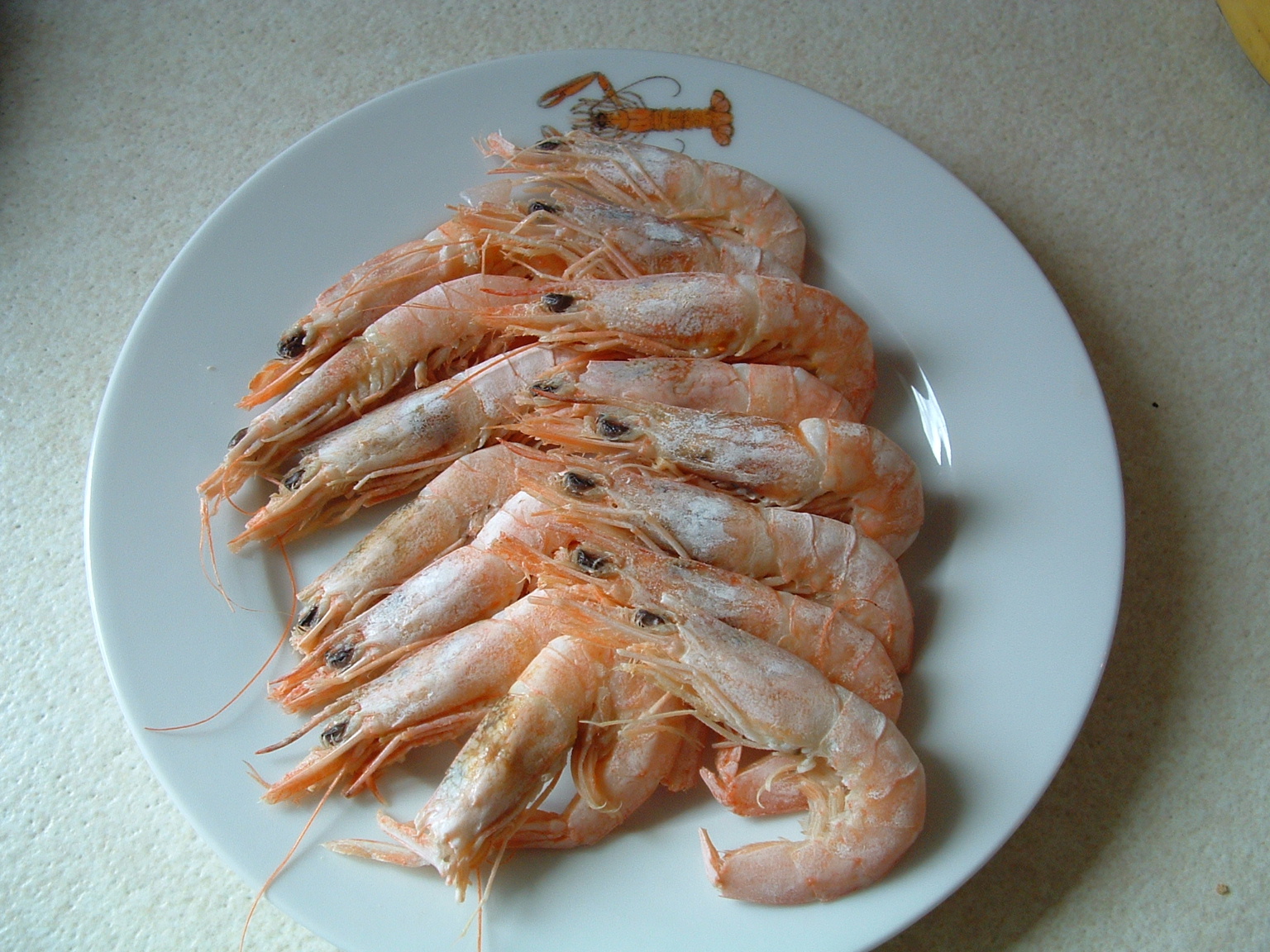

The small Gambero Rosa were very different to the Rosso. Visually they were not as striking, however they were a very nice looking soft pink in colour. Quality wise, once defrosted, they were not quite as good as the Rosso but this is common with smaller prawns and sizes of green refreshed prawns 60/80 or smaller always suffer with softness and detached heads. As with the Rosso I poached them but this time for just under 1 minute. As a poached product in plain water they were nice but not amazing. A good pinch of salt would certainly aid the flavour. But wait - when fried in a small amount of hot olive oil and eaten shell on everything changed. A wonderful taste with the added crunch of a crisp shell and suddenly a very different conclusion; I could eat these all day. Additionally the Rosso were fabulous fried.

Rosso & Rosa lightly fried in extra virgin olive oil
Striped Prawn Mazzancolle (Penaeus Kerathurus)


I recently had a twitter conversation with a fishmonger about these prawns whom said that a Spanish customer of his was adamant they are the best prawn caught in the Mediterranean. He could well be right. Simply poached for 3 minutes they were stunning. Great looking prawns, meaty, juicy and so flavoursome. Being slightly bigger than the other two prawns they cope with the freezing process slightly better. The product also has a light ice glaze which protects the product when frozen. You may have noticed from the photo of the Rosa that they looked a little dry when raw. This is a result of freezing with no glaze.
So which was the best? A very hard one to be honest as they are all unique. Sitting in a restaurant I would like to have the Rosso placed in front of me. A simple but visually fantastic dish can be produced with these prawns and if a chef is attempting to turn the heads of his diners the Rosso is a no brainer. They also taste amazing so maybe they come out on top, but I can't help but consider the Mazzancolle which were incredible. Sadly the Rosa seem to dry a little as a result of the freezing process.
Southbank Fresh Fish
020 7639 6000
Saturday, 10 March 2012
Talking Fish & Hastings Day Boat Turbot
I’m obsessed with accuracy and attention to detail which on many occasions looses me the chance of a sale or the winning of a restaurant’s contract. You may be thinking this is a strange statement but businesses solely look for the cheapest price and will accept what they are told if they get it. By trade I am not a salesman, I’m a fisheries scientist, and being fact driven is how I have evolved. Some might suggest I am now in the wrong position (as a salesman), however I am meeting more and more chefs and restaurateurs whom really want to learn about their seafood. They are putting a much higher value on the service of factually correct and educational information. No longer is a box with fish delivered at a cheap price enough – the business model has evolved and places are opening up for people like myself with an honest passion and knowledge for fish and seafood. Us as consumers rely upon the menu writer, the front of house/waiting staff or the chef to serve us high quality food coupled with information about the meal itself and its noticeable fish and seafood finds itself at the very top of the agenda.
Recently I have been lucky enough to see some particularly special fish caught by small English South Coast day boats. I do hear this phrase ‘Day Boat’ used nearly as often as ‘Sustainable’ and like the latter it can be used in the wrong context. I guess it is easy to write either of these two statements if it is the information that has been passed on. In reality Day boat fish are commonly stunning in quality and sometimes have a price to match. This week our depot has been receiving fabulous fish out of Hastings with Brill, Plaice and MSC Dovers to name a few. However, the most remarkable fish on show were the Turbot. The nature of a Turbot, being a benthic inhabitant, means it is commonly captured by more aggressive bottom beam trawl methods; additionally they can be captured by mid water pelagic otters trawls. Neither methods are associated with day boats so when such a beast as the 8.2kg fish pictured below arrived the quality, compared to many beamer caught turbot, was so remarkable I had to share it with you all.


Tuesday, 24 January 2012
It's Not Just Cod, Its Skrei Cod
I’ve seen some good looking fish in my time but today I saw something very special. Now you may roll your eyes if tell you it was cod “what’s special about that? everyone has seen a cod?”. And how true that is, everyone has seen a cod, especially me, however this is any old cod, this is a Norwegian delicacy cod, this is ‘Skrei’.
What first catches the eye about a Skrei cod is its colour. A very very dark top skin, glistening in the artificial light as the ice melts and runs down the flank.

Then the striking deep green of the body becomes apparent – just hypnotic. A prod and a poke and suspicions are confirmed; the flesh is as firm as when it left the sea on the end of a Norwegian fisherman’s line.

As the blocksman removes the fillets for a yield test of the first batch the beautiful large white flaked flesh was exposed. This was turning into fish porn!

So what is Skrei cod?
Well as you may have already gathered it’s a Norwegian line caught cod which is targeted only by small day boat fisheries. Due to the immense volume and the short term migration Skrei is there only for taking between January and March. For me the importance of this product is that it is one of the few Marine Stewardship Council’s (MSC) accredited species that arrive at market in exceptional condition and competitively priced. Condition is so important to the fisherman that only fish without skin blemishes can be packed and sent as Skrei (Unfortunately since the supermarkets have jumped on the ‘Brand mark’ bandwagon they have forced the price of many of our local sustainably caught species which then usually arrive to the counters in less than perfect condition). Additionally Skrei is supported by the World Wildlife Fund and remember when buying true Skrei will have the tag attached to the forward dorsal fin or the fillet should come with this reference.

There are a few articles on the internet explaining the Skrei phenomenon in more detail with this being probably the best
Skrei, the Norwegian miracle
Additionally if you can lay your hands on a copy of January’s edition of ‘Restaurant’ magazine there is a superb article on page 42.

I couldn't help but put a picture of my hair net on :-)
Monday, 18 April 2011
Sydney Fish Market

I'm happy to admit that i am a fully fledged fish geek. Whether i be on holiday, working or just passing through i feel compelled to stop and look at the fish on sale. I do look at quality as i love testing my ability to pick fresh from old and i love looking at artistic displays, but in reality the fisheries scientist in me is always looking for species i have not seen before as that is what's really exciting. Imagine my excitement when all of a sudden i was in reaching distance of two of the worlds most prestigious fish markets, Tokyo & Sydney. Due to the earthquakes in Japan i have had to put off my trip to Tokyo, but i have finally managed to make the Sydney fish market.
The Brisbane and Melbourne fish markets were very poor in my opinion, although not as bad as Billingsgate but then again where is? But Sydney certainly has the wow factor. Like all other fish markets the car park is the hustle bustle of traders and public fighting each other for the quickest routes and the best views. The place itself is just a concrete building with 10 or so independent shops around the car park. Romantic it is not, historical looking it is not, a site offering the most wonderful sea food - it is.

The area that sets the Australian seafood market apart from the rest is their offer of cooked crustaceans. Whether it be Western Australian or New South Wales rock lobsters, Moreton bay bugs, mud crabs or the extensive range of prawns, one is just drawn to the colours and patterns of the displays created on the slabs. In Australia the demand for cooked seafood at Christmas is astronomical. However, there is a continued demand throughout the rest of the year which does allow shops and supermarkets to have a good offer day in day out.

The wonderful colours can be seen in the pictures above and below which make for spectacular displays.


Throw a prawn on the bar-b they say. Well I'm not sure how accurate that is as the majority sold are already cooked. There are some wonderful flavored prawns out here especially the Queensland banana prawn and some of the jumbo South Australian Tigers. And what makes them so great in a display is the subtle variance in colours from bright red, through the orange shades onto a dull pink. When set out on a slab it is quite hypnotic.


Very few crustaceans seemed to be sold alive or even raw. I am not sure why this is as the majority of Aussies know exactly how to prepare and cook them. Maybe it is a lazy option? Anyhow the rock lobster is a most beautiful creature and i managed to find a few lives ones at the market.

One thing that is very different in this area of the world is the way oysters are sold. Imagine how Pierre would frown if he saw opened oysters on a tray at his local Brittany fish market. I had never seen this concept before and i guess its a great way to move volume. I can confirm, however, that shucked and eaten immediately far supersedes previously opened on both taste and texture. I do love the way they are displayed like this.

Until visiting Sydney i hadn't seen any eye catching seafood displays in Australia (the best have been created by me 9if i do say so myself) when involved in store openings and workshops at a well known supermarket). The displays in Queensland seem very regimental in their style and I'm guessing they are attempting to use quality as the selling point. NSW has a very different approach, a more loving and caring approach displays are set out with pride.

The fish at the market was beautifully fresh. It was difficult to find examples of old fish on display. Of course this is how it should be. They are professionals, they understand how to look after fish to prolong its shelf life and would have a great understanding of potential sales versus ordering patterns. Only when one fully understands this within their own seafood business can they truly offer a display with few blemishes. These guys have nailed it!


On the visit i had a secondary agenda. I was in the process of producing some specialist seafood workshops for a number of supermarket stores and decided they needed to see photos of high quality product. I love the photograph above. When you look closely the two different quality products can be seen intermingled to disguise the older ones. A common trick :-)

Some examples of sashimi cuts of salmon, tuna and octopus.
Sydney fish market is a wonderful place and a mecca for any fish loving foodie. A must visit.
http://www.sydneyfishmarket.com.au/
http://www.sydneyfishmarket.com.au/
Thursday, 20 January 2011
The Fish Fight has Only Just Begun
So its taken a couple of celebrity chefs and an evening slot on C4 to achieve something Charles Clover’s End of the Line failed to do – ‘Gain support’ I am unsure as to whether Hugh’s fish fight campaign will change the ways of those select unscrupulous fisherman that continue to discard everything they catch until their bow is full of prime sized species; I am unsure as to whether the EU will take on board the significance and act on half a million signatures over the best available scientific advice that they already use; I am unsure that the biggest and most destructive of fish catching nations will be deterred from targeting endangered species on a call from a man that lives in a River Cottage. However, what I am sure of is that the tide is turning. Supermarkets have responded immediately to a call of change from their clientele and independents are offering more diverse species otherwise thought inedible. We can only all hope that if the demand drops from the end user followed by the retail sector then the fishermen will target alternative species. Of course whilst Europe still pays a premium the species will continue to be a target, but one small step at a time. Many said the management programs for North Sea and Eastern Canadian Cod stocks were too little too late. This has shown not to be the case and with time and careful management species will recover, its what they do best.
So what can we do?
Well keep this bandwagon running. Be the one that reads the correct material and I don’t mean newspaper articles, but books or websites from genuine sources. Take time to understand why you are changing your eating habits and don’t just do it because Hugh told you too. The fish and fisheries world is very complex but also fascinating. The more you understand the better you will feel when you choose your dinner. Don’t expect good advice from a supermarket as it will generally be littered with inaccuracies and don’t walk into an independent fishmonger expecting a) him to know absolutely everything and b) him to be absolutely honest. Unfortunately there are people out there, like in any business, who will say exactly what you want to hear. Become friends with your fishmonger it’s the best way.
So to help you understand the complexities of this subject I have listed some extra reading below. Many are anti fishing so will give extreme views and apply exaggerated scare mongering but that is the only method that drums the message across. If you find more useful sites please don’t hesitate to post them in the comments.
Happy reading and remember to make the ethical choice :-)
Hugh’s Fish Fight Homepage – have you signed up?
MCS – MARINE Conservation Society Homepage
Buying Guide – direct link to the FISHONLINE ethical buying chart
FISHONLINE - identify which fish are from well managed sources
Seasons Guide – You know what to eat but do you know when?
Good Catch - designed to help you make responsible decisions about which seafood to put on your menu
http://www.goodcatch.org.uk/be-informed/good-catch-essentials/
Red List – The IUCN Red List of Threatened Species
Line caught – Website dedicated to the line catch Cornish industry
The End of The line Homepage
Fish2Fork – Follow up to The End of The Line pinpointing fish selling practices of top restaurants
Sunday, 19 December 2010
Gravlax Just In Time For Christmas
Gravlax derives from Scandinavia and is a very simple process of dry-curing by marinading in salt, sugar, pepper and Dill. The result is a delicious dark, firm dill salmon perfect for Christmas or Boxing Day starter.
Firstly your salmon needs to be fresh as it could be up to twelve days old when finally consumed. When buying salmon from your fish monger look for bright and visually appealing fillets. Avoid fillets that show signs of:
Gapping – The flakes of fish appearing to be open. Commonly seen along the line of pin boning or on the fattier sections of the belly flap. Gapping is a sign of old fish.
Soft texture – Old or badly handled salmon will be soft to the touch. If you can press your finger onto the skin and the indentation remains or retracts slowly the fish is to be avoided. Bare in mind if the fish has been scalled the fish will feel slightly softer to the touch so a little leeway should be given.
Patching or lightening of colour – If the salmon has lighter colour patches on the flesh this is probably due to ice burn or water absorption. This is usually a result of poor handling. Although this has probably not affected the freshness and it would cook fine it is not ideal to use for gravlax.
Gravlax requires two matching pieces of salmon fillet with identical thicknesses. This is not the easiest to obtain unless you are great friends with you fishmonger, therefore I would suggest ordering the whole fish (a 4kg head on gutted salmon will yield two skin on sides of approximately 1kg each) then have your fishmonger scale and fillet it for you. When at home you can cut and match your own size. Don’t forget to take the bones as you can scrape enough meat from the frame to make wonderful fishcakes.
For every 1 kg of salmon cured you will need the following ingredients;
1 medium/large bunch of dill chopped
65grms coarse sea salt
50grms white sugar
1 ½ tablespoons of crushed white peppercorns
1. mix all of the above ingredients together
2. lay one of the salmon fillets skin side down on a large piece of cling film
3. cover the upwards facing flesh evenly with the mixed ingredients
4. place the second fillet flesh down on top of the first
5. wrap tightly three or four times with cling film
In the past I have experienced a problem when the marinade (the marinade is produced when the salt draws the water from the fish which then mixes with the other ingredients) leaks from the wrap. Recently I have found better success just wrapping tightly in a food bag. Once wrapped place on a tray and put into the fridge turning every twelve hours. You can place a weighted plate directly on top which helps by forcing the fillets together. The salmon can be cured in the fridge for up to seven days, but I usually do around five. Once cured it has a further shelf life of five days.
When cured the salmon calves easily due to its now firm nature. Try to cut thinly, however not as this as regular smoked salmon. There are some great ready made dill sauces than can be served as an accompaniment but I tend to use creamy sauces such as horseradish and mustard as it balances nicely against the dill marinade.


So there you have it one of the easiest, yet most striking fish starters you can make. Once you have mastered the simple version you can move onto varying the cures to suit your own taste.
Beetroot Cured Salmon
Saturday, 18 December 2010
Hi All,
Apologies for a lack of content recently but unfortunately my current job doesn't really offer me the correct information to blog about. I now work for Australia's largest seafood company and spend most of my time in supermarkets offering seafood specialist support to improve standards; Would actually make wonderful reading. Whilst in Australia I had hoped to spend a lot of time fishing, catching, preparing, cooking and blogging the outcome, however, Queensland is in its wettest and stormiest spell for 10 years so that has put pay to that. So all i had was the cricket, but that went pear shaped at the WACCA yesterday. Anyhow i will endeavor to find subject matter whilst i am here in Australia or alternatively when i return.
I have a twitter paper running daily which collects and publishes all the most recent news in the industry so it well worth a look.
The Fish & Seafood Daily
Mat :-)
Apologies for a lack of content recently but unfortunately my current job doesn't really offer me the correct information to blog about. I now work for Australia's largest seafood company and spend most of my time in supermarkets offering seafood specialist support to improve standards; Would actually make wonderful reading. Whilst in Australia I had hoped to spend a lot of time fishing, catching, preparing, cooking and blogging the outcome, however, Queensland is in its wettest and stormiest spell for 10 years so that has put pay to that. So all i had was the cricket, but that went pear shaped at the WACCA yesterday. Anyhow i will endeavor to find subject matter whilst i am here in Australia or alternatively when i return.
I have a twitter paper running daily which collects and publishes all the most recent news in the industry so it well worth a look.
The Fish & Seafood Daily
Mat :-)
Saturday, 9 October 2010
Snappers
I will always argue that fish from North East Atlantic have the finest of flavours and that cold water fish provide the best eating. However, since moving to the Southern Hemisphere I have had the opportunity to sample some beautiful fish including a fine range of snappers. When involved with wet fish in London I was only aware of the Red snapper which was generally the only species available at any level of quality. Here in Queensland there are a number of snappers available including what seems the most popular species of crimson snapper and frypan snapper (or frypan bream). Unlike the Red Snapper (usually imported from the Seychelles) that is commonly found in UK and has a soft texture when cooked the Australian species are much meatier with some that compare to eating steak soft steak. There texture is unlike any fish I have tried before and due to the firmness holds up well to more aggressive cooking techniques. Currently the Golden Snapper, Saddletail Snapper and Goldband Snapper are my three favorites, but I still have a number to try. When buying your fillets compare to the pictures below as they are a great guide to quality.
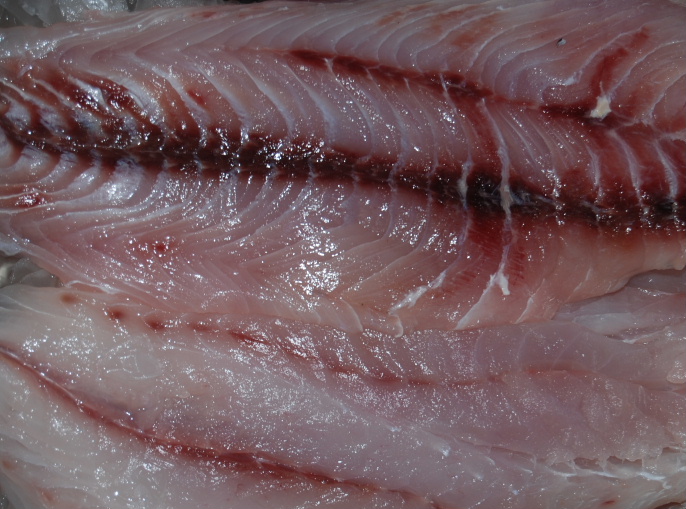
Golden Snapper Fillets

Gold band Snapper Cutlets

Saddletail Snapper Fillets
Brioche Crusted GoldBand Snapper
Barbecued Goldband Snapper Fillets in Vine Leaves with Warm Lentil Salad
Goldband Snapper with lemon
Baked Snapper
Subscribe to:
Posts (Atom)

 Posts
Posts


