Aquanaria

Aquanaria

Saturday, 21 November 2009

My old vocation - rescuing fish

As many of you know I have a background in fish that stretches further than mongery. One of the most enjoyable parts of an old job was to get wet and dirty with the fish. I wrote the account below for my old fisheries management website that details how we removed the fish out of those canals you all drive over – enjoy.


The United Kingdom has a fairly extensive canal network with lengths from Exeter in Devon to Edinburgh in Scotland. Through the mid 19 hundreds the canals became rather disused; this was due to commercial goods transport moving to the road and rail networks. However, over the past 15 years the canal has returned into the limelight with huge grants allowing essential maintenance; this is especially the case on the Kennet & Avon canal in Devizes and the Union Canal in Falkirk. This increased interest, and some may suggest trend, in living by waterways has encouraged the canal owners, British Waterways, to continue with essential work to maintain the network. So with all of this work underway how and why do fishery consultants become involved? The canals have always been a favourite haunt for anglers; this has resulted in thousands of pounds of fish being stocked over the past twenty years. On many occasions the scheduled work requires the removal of the water. The replacement of lock gates, repairs to culverts, lining of canal beds, dredging and piling are common practice, but before these essential works can commence the canal section requires de-watering.


These three images show why water is removed from canal sections. The picture at the top was taken at Farmers Bridge, Birmingham on the Birmingham & Fazeley Canal where extensive re-development work was being undertaken. A series of lock pounds were drained to allow bank side renovation to take place; the aim was to rejuvenate the area with new housing and office buildings. Of the twelve pounds along the Farmers bridge length all but one drained to an efficient narrow section on the towpath side. The image in the centre shows a lock gate renovation work at Cosgrove on the Grand Union Canal Main Line near Northampton. The removal of lock gates will always lead to de-watering. However, as many locks have a bridge situated close by the use of stop planks can be employed hence leaving short drained sections. On occasions a further problem is uncovered once the section has been de-watered. At Cosgrove (image at bottom) a hole was located in the bank, but luckily four grade 1 British Waterways staff were on hand and were left to look into it!!!


There are various ways to de-water a section of canal. Two solid barriers are required; therefore, short pounds with adjoining locks are ideal. Unfortunately this scenario is rare so other water retaining methods need to be employed. Stop planks can be placed in the purpose cut grooves located underneath bridges.


When the use of stop planks and lock gates as dams is not possible temporary structures are required to hold vast quantities of water back. The common choice is the use of an impervious fabric membrane attached to a free standing steel support system. These Portadams are fixed across the canal, shown in the above pictures (Horton Bridge, Kennet & Avon Canal), and then with a slow drain down the sheet is allowed to seal creating a water tight barrier. This system allows work to be undertaken on otherwise non-accessible sections. However, they have a tendency to breech, especially in the more silty sections, so jobs are commonly held up while complete sealing takes place.


These two images show the completed dams in place. At the top is the dam at Horton on the K&A Canal; note the drag net can be seen still in place behind the now completed dam. Below is the fitted dam at sheepcote street, Birmingham. This was a larger dam thus did experience many problems before a seal was achieved. The ideal conditions for a successful fish rescue consist of a width near to 4 metres and a depth 0.45 metres. However, these conditions are rare due to the varied contours found on the many different sections of canal. Silt deposit levels and recent dredging exploits also influence depths. Whatever the conditions presented the rescue needs to be completed, therefore methods vary to suit each job.

The concept is simple. A small boat is pulled along the canal section behind 3 - 4 electrofishermen. The boat contains a generator linked to a control box. From this box run two hand held anodes and one cathode; this is connected to the rear of the boat. 240 volts and 6 amperes are generated and a direct current is implemented. The current is applied via the use of two "dead man's switches", one on each anode. Also within the boat there can be up to four large bins of water which hold the captured fish.; each bin has an aerator pipe that is connected to a battery powered air pump. Up to three stop nets of various sizes can also be carried. Each bin can hold up to 100lbs of large fish or 50lbs of small before they need to be emptied.

With a three man team the outside men will control the anodes, sweeping left to right, whilst the centre man controls the boat. Each team member will also use a small net to collect stunned fish. Large nets are held in the boat if substantial amounts of fish are encountered. If a forth team member is utilized the man can be placed in one of two positions. If the presented canal still has a wide area of water the forth man would be suited at the front alongside his team members. However, if conditions are either 1) good (narrow); he can follow behind netting the smaller fish that rise late (usually perch & ruffe), or 2) Very silty; he will probably have to push the boat if the substrate offers difficult walking conditions.

The length of the canal section is the usual determining factor that dictates where the job will commence. It is beneficial to work into clear water, therefore, if groundwater is entering on the length then the electrofishing should always take place towards the source. However, if the section is being pumped or drained whilst the rescue is in progress then working away from the running pumps or open paddles is again preferable. Incidentally, it is not always possible to fish into clear water as accesses are not always available to launch the boat from.

Once a suitable area has been found for launching, and the water flows and colour has been assessed, the work can commence. The process is fairly simple, however, there is one hard and fast rule. No matter what conditions are presented the job is not complete until all of the fish have been removed. This could mean up to four runs of the whole length; usually two complete runs are sufficient to remove the fish.


These three pictures show a successful fish rescue in progress at Yelvertoft on the Leicester Line of the Grand Union Canal. These conditions are almost perfect offering a narrow canal and constant depth. The silt levels through the boat channel are low which allows easy walking conditions. Unfortunately I needed to leave the water to take these pictures, however, with the offered conditions I would have been seen approximately 20 metres behind the boat collecting the smaller ruffe and perch that show late. The electrofishermen can be seen on each side with a hand held anode and an accompanying netsman in the centre. The pictures givesa good indication of the parallel line kept by the probe users. If one were to fall behind, this coinciding with large numbers of fish, then the fish shoal will tend to charge the withdrawn side. If kept level the fish are moved slowly up the canal until they meet a solid barrier; a net can be dropped behind at this point trapping the fish into a short section. The creation of a diagonal current caused by a withdrawn anode will cause increasing problems as a section becomes wider. The section above is sufficiently narrow so not to be effected by sloppy working practices.


The picture on the top gives a clear view of the contents inside the electrofishing boat. The electric box can be seen on the front of the boat (grey) with the yellow cables of each anode attached via specialised waterproof four pin plugs; the UK standard colour for these plugs is blue/grey. The box is connected to the generator (red) which is situated in the rear of the boat. The generator can usually be found in the rear as it counteracts the water bins (yellow) in the front. To the left of the generator the air pump can been seen; the pipes and diffusers from this pump run to the water bins. There can be up to five bins in the boat at any given time. The picture on the bottom shows an electrofisherman (that's me) working an anode whilst netting small roach. He can be seen in a full dry suit and gloves, the only realistic clothing to carry out fish rescues in.


These two pictures show the working conditions in and around solid structures. The image above shows a simple lock system that requires navigating before the next section can be fished. Note the large amount of ice in the lock; never assume all jobs are warm and fun!! The second image gives an excellent view when approaching a portadam.
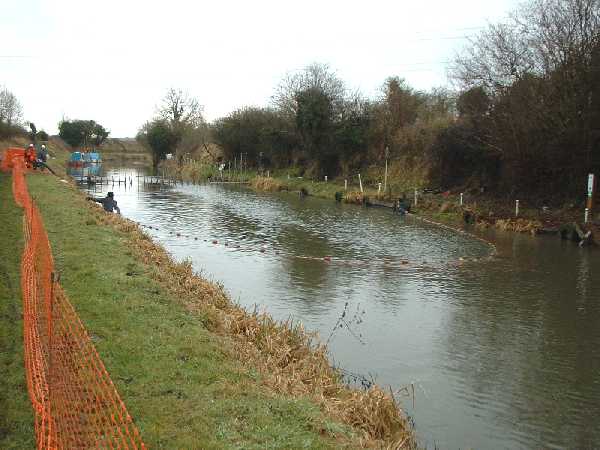


On occasions it is possible to carry out a drag down with a net before a dam is put in place. These pictures, taken at Horton Bridge, near Devizes on the Kennet & Avon Canal, show the aforementioned drag down in progress. This method has shown to be very effective in herding shoals of bream and large roach from the target section. Years of scientific testing, with regards to the effect of electrofishing on certain species, has continuously revealed potential damage to fish when exposed to long bursts of electrical current. Therefore, any opportunity to remove fish from the section with methods other than electricity will always be employed.

A canal drag-down is usually undertaken with a small seine net rarely exceeding 25 metres in length. Again the concept is simple. The net needs to be a sufficient depth to cope with the drag-down; therefore, a net exceeding 1 metre at the deepest point of the canal is required. A man works each bank from the water by pulling the net towards the dam frame; it is imperative that the net stays of equal distance between workmen. The middle of the net needs to be in the centre of the canal. The images above show the net being pulled towards the dam frame (top) and of the excess net bulging behind as the net is pulled (centre). Incidentally, this method is not always feasible as dragging nets is both time consuming and energy sapping. In reality very long stretches cannot be netted as the efficiency decreases over long lengths due to snags.

As a net is pulled through a section numerous obstacles will be encountered. Many areas of canal are used as dumping grounds for all types of rubbish; this will affect the efficiency of any drag-down. As these snags are uncovered the leads attached to the base of the net need careful manoeuvring over the obstacle. The worst type of snags include bicycles, tree branches and brambles and the mandatory car engine. However, if the canal is not to deep most problems can be solved. This image (bottom) shows a large branch being removed from the net.
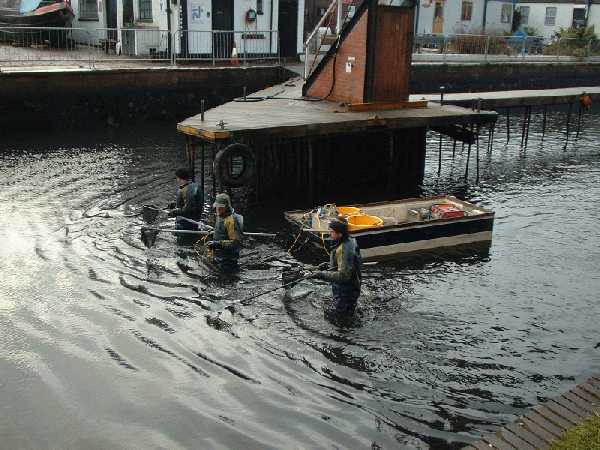


These two images taken at Sheepcote Street, Birmingham on the Birmingham & Worcester Canal, show a relatively inefficient electrofishing exercise. The catch efficiency of a canal section drained to this width would be less than 50%, however circumstances sometimes dictate that rescues need to go ahead. This section had prolonged problems with holding water back, but the section was finally drained and a successful rescue was completed.


Occasionally some very difficult conditions are put in front of a rescue procedure. As many rescues are linked with hugely expensive civil engineering projects the time scale available is always short. Therefore, problems other than deep water, which cannot be solved, require tackling and over coming. These two images were taken in January 2002 at Yelvertoft on the Grand Union canal Leicester Line. This stretch was approximately 2200 metres in length and when presented had 2 inches of ice across the surface. For obvious reasons a rescue could not be undertaken, the only solution was to launch the boat, find some heavy poles, and then tow the boat whilst breaking the ice.


What 'Cod' the prize be?

Roll up roll up come and get your raffle tickets. Bottle of wine? Box of chocolates? Cuddly toy? Oh no in a strange twist of events The Marine and Fisheries Agency have decided to pop all the members of the under 10 metre vessels fleet into a hat for a draw with the prize being 18 tonnes of Eastern Channel Atlantic Cod. Of course small print is in place to be eligible but 36 of those lucky enough to be in the hat will be rewarded with a catch limit of 500kg of cod each to be caught between the dates 1st -31st December.
‘Before starting to fish for their 500kg of cod winners will have to receive an EU log book and permit letters'
How bizarre is all this? Why could anybody think the allocation of fish quotas in this day and age is dated when such games are used to decide people’s livelihoods? Not to forget the sleepless nights poor Charles Clover will have when he finds out “his fish” are been given as a prize in a raffle!!

Sunday, 15 November 2009

Fish Locomotion

Fish species are present in many varying forms all over the world. The main difference between shapes of individual species would firstly be concern the need for them to travel through a fluid with varying densities pressures and drags. With a combination of these problems and in tern making best use of there form inside their chosen environment each species has developed, sometimes radically, different body profiles.


Species such as the rainbow trout (Oncorhyncus mykiss) have developed torpedo shaped bodies to counteract the drag confronted in a viscous fluid. Figure 1 shows the difference in streamline effects on two very different shaped objects in a fluid. The ideal situation to experience in a viscous fluid would involve laminar flow, this being smooth and thin with a creation of minimal drag. The circular shape in figure 1 is less streamlined in appearance and at the rear end turbulent flow is created. This is usually in the form of an eddy or wake and consists of a thicker layer, which increases the drag. For many fast swimming species the creation of a turbulent flow would result in the inefficient use of resources with respect to energy requirements. This may seem fairly straight forward but Blake (1983), suggests although the maintaining of a laminar boundary layer is a drag reduction system it happens to be less stable than a turbulent flow as it creates larger pressures upon separation.


Figure 1: Comparisons of flow around objects in viscous fluids. Source: Hosford (1997), p.16


As this is the case the inducing of a turbulent boundary layer can also reduce drag. It has been suggested that some species such as the mackerel (with the use of added dorsal fins), and the rainbow trout (with the use of an adipose fin) tend to induce a change in boundaries. Figure 2 shows that many years of development in aerofoil technology have created a design identical to the shape of a rainbow trout. The solid line is the aerofoil where as the dotted line is the trout. This concludes that the rainbow trout has formed into a highly streamlined structure.


The position of the shoulder will determine the type of flow over the body of the species. The shoulder of the trout is somewhat further back than the likes of the common bream (Abramis brama). This seems to verify that the form compares to the habitat and lifestyle of the species. The final point on the subject of drag would involve the use of the mucus covering the skin of the fish. The use of mucus in filling irregularities on the body could improve the flow characteristics of the boundary layers.


Figure 2: Comparison of a trout body form and a typical aerofoil. Source: Blake (1983), p.61


In normal observations fish swimming can be split into steady speeds, where the fish moves in one direction at a constant velocity or more commonly un-steady swimming which is the continuous changing of speeds and directions (Hoar, 1978). The critical speed of a species can only be measured from steady swimming but it is important to note that three other phrases, prolonged, burst and sustained swimming will take place in either of the firstly mentioned descriptions. It must be mentioned that potential growth response is effected by the cost of locomotion, which in tern contributes to the overall metabolic load (Ware, 1975), therefore efficient energy use is essential. Evidence has been found that juvenile fish do feed by moving at the appropriate speed to maximise their production rate (Ware, 1978). Figure 3 shows the fatigue curve of a rainbow trout (formally Salmo gairdneri). It clearly defines the three states of swimming used by all species of fish. Sustained swimming includes routine activities such as schooling and cruising and can be maintained in excess of 200 minutes. Prolonged swimming can continue between 200 minutes to 15 seconds and entails cruising with short bouts of vigorous movement. Burst swimming is the most inefficient form of activity with respect to energy use and can only be achieved for short periods of up to 15 seconds (Wilson, 1994).


Figure 3: Fatigue curves Source: Blake(1983), p.38


The rainbow trout can be classified into the group of subcarangiform fishes. This defines the type of body movement the species experiences when swimming. Most fish species swim with lateral body undulations running from head to tail. These waves run more slowly than the waves of muscle activation causing them, reflecting the effect of the interaction between the fish’s body and reactive forces from the water (Wardle, 1995). The undulations of the side to side movement in the body are slight in the anterior but there is a significant increase in the rear half to third of the body. The snout of the fish does not travel in a straight line but tends to oscillate at small amplitudes along the mean path of the fish (Hoar, 1978). Figure 4 illustrates this type of movement and clearly shows that no part of the body travels in a straight line, but tends to follow a curving path through the water.


Figure 4: Body propulsion of subcarangifom mode. Source: Hoar (1978), p.10


Only at speeds of under 1 to 2 body lengths per second does the amplitude of the body undulations change, usually there is no change with swimming speeds. The frequency that the tail beats and the velocity at which waves are passed to the rear of the fish directly effect the speed of the fish. Speeds of up to 25 body lengths per second have been recorded for fish below 1 metre in length. Although this measurement is for fairly small fish, Webb (1975) discovered that maximum acceleration rates for rainbow trout (40-50cm/sec2) were in the same order for other fish from a wide range of sizes. This suggested that maximum acceleration rates may be relatively independent of size. Although acceleration and size may not be comparable the wavelength of the body undulations remain constant when relative to the body length within species. When the size of the fish increases the attainable maximum frequencies decrease. In relation to tail beats and swimming style, Webb (1991) found that over a period of 226 completed tail beats from trout no constant speed was registered. Figure 5 shows the results and clarifies that sustained swimming is never constant and will always involve acceleration, deceleration or turning.


The caudal fin is probably the most important attachment used for acceleration. During Webbs (1977) experiment involving fin amputation of rainbow trout he clarified that the large caudal fin is required for maximum acceleration performance and creates the majority of generated thrust during fast starts. The dorsal and anal fins are also important in generating thrust but they are not as nearly as significant.


Some of the important aspects involving the movement of trout have been discussed, finally but just as significant is the production of energy needed to create these exercises. The thrust force of the fish is produced by contractions of the propulsive musculature. The velocity that the muscle contracts dictates the power that the fish can produce. Muscle structures of fish can be split into white and red types. Red muscle consists of up to 20% of the total belonging to the trout (less for lower active species such as carp (Cyprinus carpio)). This muscle has a low rate of fatigue and is used for all of the low speed sustained cruising. The white muscle fatigues more rapidly but gives maximum power output, which is used for burst speeds. Due to the speed of fatigue the white muscle can be used only for short periods of time.


Blake, R.W. (1983). Fish locomotion. Cambridge university press, Cambridge.

Hoar, W.S., and Randall, D.J. (1978). Fish physiology, volume VII: Locomotion. Academic press, New York.

Hosford, M.B. (1997). Fluid dynamics of ship resistance and propulsion. Institute of marine studies, Plymouth.

Wardle, C.W., Videler, J.J., and Altringham, J.D. (1995). Tuning in to fish swimming waves: body form, swimming mode and muscle function. Journal of experimental Biology, Vol 198, p. 1629-1636.

Ware, D.M. (1975). Growth, metabolism and optimal swimming speed of pelagic fish. Journal of the fisheries research board of Canada, Vol. 32, p. 33-41.

Ware, D.M. (1978). Bioenergetics of pelagic fish: Theoretical change in swimming speed and ration with body size. Journal of the fisheries research board of Canada, Vol 35, p. 220-228.

Webb, P.W. (1975). Acceleration performance of rainbow trout (Oncorhyncus mykiss). Journal of experimental Biology, Vol 63, p. 451-465.

Webb, P.W. (1977). Effects of median-fin amputation on fast start performance of rainbow trout. Journal of experimental Biology, Vol 68, p. 123-135.

Webb, P.W. (1991). Composition and mechanics of routine swimming of rainbow trout, (Oncorhyncus mykiss). Canadian journal of fisheries and aquatic services, Vol 48, no. 4,

p. 583-589.

Wilson, R.W., and Egginton, S. (1994). Assessment of maximum sustainable swimming performance in rainbow trout. The journal of experimental biology, Vol 192, no.1, p. 299-305.


The Ultimate Sacrifice

So I whinge I can’t get fish. My customers complain that they can’t get the fish they want. My wholesalers complain they struggle to get fish. This past couple of weeks has seen some of the worst storms for nearly a decade with 70mph+ coastal winds, flooding, extensive damage to property and yet we still expect fish. As fish go short the price increases as wholesalers and exporters bid against each other for the morsels. The over worked, under paid, fisherman eye a chance for a better return and risk their lives for this and ultimately to put fish on our plates. Again last weekend we lost another brave crewman who was washed over board into the English Channel from the Brixham trawler the Korenbloem. Young James Grindy was heroically pulled from the water by two of his colleagues who dived into the icy water with no concern for their own safety. James was taken by the air ambulance but died later in hospital. I would like to say many understand the dangers of being a fisherman, however, many more do not. Make it you business to realise what some people do to supply fish – sometimes the ultimate sacrifice

Monday, 9 November 2009

Trees and Deers and Fresh Air

Occasionally the outskirts of London offer a real getaway from the hustles of our packed metropolis. The expanse of Richmond Park in late Autumn is a place to be savoured. Beautiful colours, majestic wildlife and if you can’t bear to be with out a latte maker in every car park.


Less Fish Higher Prices

The European Commission recently published it’s proposed changes for 2010 Total Allowable Catches based on best available scientific and catch data. As expected a number of fisheries have proposed reductions in total take by fisherman. The commonly known plight of Cod in certain areas continues with proposed 25% cuts in nearly all fishing grounds around the UK. The haddock fishing grounds off West Scotland have a massive proposed 54% cut. Among others the eastern English Channel may have a 15% reduction in Skate & Ray landings. The plaice fisheries of Western Ireland, the Bristol Channel and the eastern English Channel have proposed 15% cuts. The North Sea has further 15% cuts in Turbot and Brill catches. The good old sustainable Pollack fisheries of the whole west coast will be cut by 15%. Many Dover sole fisheries have be cut by between 7 and 31% with the eastern English Channel suffering most. Also many langoustine fisheries have been cut by around 10%. Interestingly no monkfish fisheries are cut and one has increased by 15% indicating good stock status.

So be prepared for increases in the price of your fish. The Scottish fisheries are hugely important to the British fish haul and with potentially huge reductions in landings the remaining ports will suffer increased pressure from the big wholesalers. All legally caught fish are auctioned and follow the simple rule of prices being affected by market availability and demand. Many of you would actually shudder if they new how much Cod costs at wholesale, especially as a notable percentage is trimmed off before re-sale. I am confident that the least return on any product sold by a fishmonger is the Cod so do expect it to rise in price in 2010. Additionally the haddock is a very important species to the Scottish Fleet so with the proposed 50%+ reductions huge pressure will be inflicted on the south west ports of England.

Tuesday, 3 November 2009

When The Wind Blows

Fishmongers have to face the major problem of a lack of quality fish when the weather is bad. I see many mongers quality fall through the floor when bad weather is about as they feel they have to continue to offer every product all of the time. I embrace these situations as it allows me to restrict my fare to a selection of high quality sourced species. I recall that on my one and only trip to Borough Market a couple of years ago I saw the perfect example of this. The mentioned weekend had been towards the end of a week of some countrywide gales and quality fish was critically short. A fishmonger in the centre of Borough, whose name I am unaware, had a huge selection of species with much interest and many sales. The quality was awful. Apart from one piece of tuna there was not an item I would have allowed on my counter. Walking out of the market rather bemused and disappointed I noticed a fishmonger called Applebee’s. I popped in and introduced myself and was pleasantly greeted with a small selection of great quality. Not a chance were they going to compromise their standards for market tourist trade.


Remember that our fish are not kept in fields with fences penning them in. When bad weather is about be prepared to change your menu as many fish will not be available. Also be prepared to be offered low quality if you visit a shop that puts profit over pride. I am not ashamed to say I only had 22 species (including each shellfish and prawn) for sale today. I am, however, proud to say I sold them all.

Monday, 2 November 2009

Skating on Thin Ice - The Plight of our skates and rays

Skates and rays are ancient and stunningly beautiful creatures thought to have been with us for 150 million years. There are approximately 600 species throughout the world including 21 around the coast of the UK; varieties also include electrical and stinging species. They derive from the class Chondrichthyes and fall into the sub-class elasmabranchii that also includes the sharks. The close relationship of the skates and sharks mean they both differ from the bony fish as their endoskeleton is made entirely of cartilage. The differences do not stop their as unlike many bony fish the skates and rays do not have scales; they are either armed with mucus covered skin, common to the spotted ray, or bony armoured projections called tubercles. They are very sociable animals and can commonly be found in large groups sometimes in piles on top of each other. They glide effortlessly through the water using their huge pectoral fins, commonly known as wings that move by waves of dorsoventral muscle contractions, whilst using their long whip like tail as a rudder. Their beautiful markings, normally characteristic of their specific environment, are used as camouflage as they lie lifeless disguised on the sea bed; camouflage on the sea bed is a great form of predator defence.

The beautiful markings of a Cuckoo Ray

They are slow moving bottom dwellers and spend a large amount of time laying on the sea bed so have their mouth on the underside of the body which traps prey against the substrate. They are ambush predators commonly laying in wait too pounce on their unsuspecting prey grasping them with compact rows of strong pointed teeth.

The skates and rays have evolved additional help in breathing; their five to seven pairs of gills on the underside of the body would continuously become clogged with silt if no help was at hand. On the top of the body, alongside each eye, there is an opening called a spiracle. Water is taken into these vents and then past over the gills allowing the oxygen to be removed. Similar to sharks the skates have great senses and having electro receptors that are able to detect electricity produced by prey.


Male skates have specialised fins known as claspers that can be seen either side of the tail on the underside. Mating is quite violent with the males commonly biting into the females. The fish generally have a late age at maturity, between 5 and 10 years, and the females produce only a small number of spiny egg cases, less than 100 per year, and these are commonly known as mermaids’ purses. Depending on the species and certain environmental factors their eggs can take 6 to 12 months to hatch; some species of sting rays do bear live young.

The catch levels into UK ports of the main species approaches 2-3000 tonnes per year. Considering that nearly all caught skates are part of the bottom trawl by-catch these levels are quite high. Being a by-catch species has particularly bad consequences as it is very difficult to ascertain accurate catch levels. Managing fisheries with figures ascertained from by-catch data make effective fishery management hugely difficult. Additionally over the past decades all species have been recorded in the generic skate and ray family resulting in little or no accurate historical commercial catch records; without this data it is impossible to assess stock level fluctuations over time. Since 2009, however, a species specific recording system has become compulsory. The retention of the common skate species is now illegal in the majority of the Europeon waters and must be returned alive if caught. This is also true of the undulate ray species.

Of the many species across the world we need only to centre around a small percentage of local varieties. The stage is taken by the critically endangered common skate (Dipturus batis), the species of categorised ray thought to be at low or critical levels n certain areas including the Thornback (Raja clavata), Undulate (Raja undulata), Blonde (Raja brachyura) and Painted or otherwise known as small-eyed (Raja microcellata) and the species deemed at safe levels which include the Cuckoo (Leucoraja naevus), spotted (Raja montagui), and the Starry (Raja radiata).

So why has the skate, and to a lesser extent certain species of ray, found themselves on the endangered list. They are not particularly fashionable like the blufin or other species of tuna, delicate like halibut or even as easy to cook as cod. Unfortunately the skates and rays have one huge disadvantage when compared to these species. They take time to mature and reproduce very slowly in incredibly small numbers. Unlike a mackerel that will release many thousands of eggs per fish the rays will lay a small number per female. The majority of shoaling species work on the theory that a mass production of eggs will yield a small percentage of survivors. If, for example, the female population were halved the tiny survival rate would also be halved; the problem that created the cod stocks to collapse of the west coast of Canada. So if the species only lays a small number of eggs to start with then it is critical a large percentage survive. Ultimately a stock can reach no return when the spawning stock is not large enough to successfully recruit and the species becomes extinct – when only two males are left the Adam and eve theory reverts to Adam and Steve – no reproduction.

The EC have recently proposed a 15% cut in Total Allowable Catches across the board within EC waters. The landing of Common Skate, Norwegian Skate, White Skate and Underlate Ray remains illegal in many European waters.

For many years the skate in England and the Ray in France have traditionally appeared on restaurant menus or in front of the family at dinner time; served with black butter and capers or more commonly in England battered with chips. In more resent times skate has become a popular dish offered by some of the top London establishments; maybe it offers something quintessentially English?

Personally, I have not seen a piece of Common skate for a number of years and although our shop is situated in the heart of London’s largest and wealthiest French and English communities the demand for this, and ray species, is minimal. I put this down to my choice of rarely offering this product; I am one of the people fascinated by them in their own environment. On a Friday the shop will offer a small amount of carefully selected ray species that I am happy with selling. I understand it can be very hard for certain businesses when the most talked about ‘must avoid’ species are also the most popular. In a way I feel sorry for restaurants such as Nobo, Scotts and Sheekeys as they are being publicly pressured into to removing dishes they have sold for many years, dishes that are signature of their restaurant, dishes that will leave gaping holes in their menus, holes that cannot be filled. However, nobody can condone the selling of an endangered species, aquatic or not, so these restaurants will have to come to terms with this and adapt their menus accordingly. Those that do not will eventually find themselves ostracised which will be more damaging long term to their businesses.

I certainly believe the majority of restaurants, including those so heavily criticised on recent ‘where not to buy fish’ websites which offer skate on the menu, are in fact selling species of sustainable ray (websites such as the recent fish2fork.com which was removed for a short period and updated as inaccuracies and assumptions where leading to possible libel action). The problem that occurs is that all these species encompass the group of true skates. All of our commercial species are then split into the larger species with long snouts (true skates) and the smaller short snouted species (rays). Although technically they can all be called skate on the menu it is time, with increased pressure of knowing some are critically endangered, to label our dishes, and in the case of fishmongers, their counters, correctly. Not until 2009 has the fishing industry been forced into labelling each variety as species specific.

Common Skate

Many chefs and fishmongers will not recognise the difference between the many species. In fact many would have never sold common skate. However, many of the menu inaccuracies involving skate are accidental and without true malice, but those restaurants that have known they have been selling ray as skate will now feel uneasy with recent publicity. Conversely, many will be happy with their labelling as technically it is correct and the assumption by the recent fish2fork website that menu citing of skate are automatically the endangered species are very assuming and in most cases wholly inaccurate. I am also told there is a certain amount of misleading undertaken by some wholesalers and fishmongers and I have also seen the smallest of immature ray wings labelled as skate in the so called ‘green’ supermarket. The real problem is that over the past ten years everybody has just called all species skate. It was just easier that way. It was a name everybody recognised. “Portion of skate and chips please love” just makes more sense than “Portion of small-eyed ray and chips please”. This however needs to change. People are aware of the uneasy plight of certain species of fish. Shops and restaurants need to re-label. It is not acceptable to sell endangered species of Skate so why use the name. The rays have such beautiful names so use it as a sale pitch.

So what is my advice on buying or not buying skate and ray? Due to the lack of data it has been very difficult in finding any real help to answer this question. The fishonline.org website offers its usual level of worthless help by suggesting the stock levels of most species is uncertain. Fish2fork seem to categorise all species as skate thus assuming they are critically endangered without any real justification. Seafish ‘the authority on seafood’ (their branding) offer little more than a lack of data gives insufficient results. The IUCN red list offers little unless well hidden in its site. For example the Thornback Ray, categorised by Seafish (with reference to IUCN) as ‘near threatened’ is actually categorised as lower risk by the IUCN – all very confusing and might I say misleading. All I can suggest is to follow the following list and you should buy the tastiest meal that hasn’t come from a critically endangered species.

Your purchased piece of fish should be as pink as possible (see picture below) – remember ‘White will be shite’. The older the fish the whiter it will be so if no colour remains walk away.

Many will know that an old piece of skate will smell of ammonia but why?
The skates retain nitrogenous wastes such as urea in their blood stream to help water from being drawn out of them via osmosis. When combined with blood salts the concentration is raised above that of the surrounding water resulting in osmotic equality. If it smells do not eat it.

And finally with regards to ethical selection the size may be your only help. As the very large species of True Skates and the Underlate Ray are now rarely or never landed I would suggest avoiding the very small wings that would come from immature fish. It is hard as the smaller species are believed to be the most abundant, but rarely will any have reached maturity at a small size. Buy whole wings that weigh 700grms+ or pieces that have come from wings this size or above. Maybe your ideal size to guarantee your fish had reached maturity and had been given a chance to spawn would be bigger still.

To note – Unlike the cleanly skinned Blonde Ray wings in the picture below the common skate has small black squiggly lines left on the flesh after skinning (they are part of the skin that remains and could be likened to black worms?) and I believe is the only species that does. If you see it for sale you’ll know it is from a critically endangered species.

I See Trouble Ahead

So is it ethical to follow the lead of celebrity chefs like Hugh Fearnley-Whittingstall? Should we choose unusual non fashionable fish that fall under ‘their own’ new favourite label of ‘sustainable’. Or maybe get into line behind Charles Clover and only eat at restaurants that he wants us too. I am confused, and trust me, when it comes to fish that is not usual. Of course the majority of fish HFW champions are not only awful to the taste, but are unavailable to buy anyway. That’s fine, but please don’t try to convince us we need to eat carp et al. Anyhow the point; I have been studying the European Communities (EC) proposed Total Allowable Catch (TAC) alterations for 2010. Although the piece I am writing centres around the popular species I did pick up on the following. The marine stewardship council accredits fisheries that can prove they are sustainable which is a very hard status to achieve. The Eastern English Channel Dover Sole fishery gained this status last year and has since won the plaudits and then recommendations of all the ‘where to source fish’ guides. Why then is there a proposed 31% reduction in the TAC of this species in this area? This to me is not showing a stable fishery? This to me is showing that even more than ever before people are jumping on a bandwagon to gain respect from the concerned public by suggesting sources of ‘sustainable, fish – sources they have no understanding of.

Secondly, everyone’s favourite savour of the ocean the Pollack. Let us open with the shuddering words from the SeaFish website that states

“Although Pollack are not an assessed species the European Union set a precautionary Total Allowable Catches based on previous catches (this can be modified based on evidence provided to the EU by the Member State making the request) for this species in the following ICES areas”

So Pollack has no assessment! This problem has caused certain species to collapse in the past and will continue to do in the near future. So, with no assessment the EC has proposed a 15% decrease in TAC which to me is very concerning. This could be construed as guess work as no member state will suggest cuts in their own fleets catch. Maybe in a few years people will be saying ‘don’t eat Pollack it is an endangered species’. And if this scenario occurs please remember the names of those who bullied us all into eating this tasteless fish for their own publicity.